
Call for papers
International Panel Shipping Process
Participate in the 1st International Interdisciplinary Congress of Social Sciences (CIICIS 2026), a high-level academic space that brings together researchers, teachers and professionals to critically reflect on the contemporary challenges of the social sciences in contexts of social, digital and cultural transformation.
CICIIS 2026 is issuing an open call for scientific articles for its various thematic areas, with a submission deadline established according to the official congress schedule. Submissions must be original, unpublished, and meet criteria of academic rigor and interdisciplinarity.
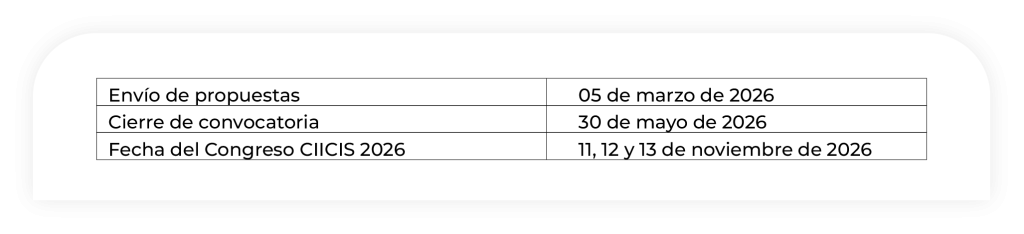
Important dates
Open Call
Submission of Proposals
05/03/2026
Call for applications closes
12/09/2026
Congress date
November 11, 12 and 13
Call for Registration of Panel Tables
What is a Panel Table?
A Panel Table is a thematic session organized by a coordinator or chair, which brings together 3 to 5 specialists who present short papers (10–15 minutes) on a common topic, followed by a moderated debate and dialogue with the audience.
Objective of the panel tables
- Promote specialized and dialogic debate
- Articulate multiple theoretical and empirical perspectives
- Generate strategic conclusions, recommendations, and future lines of research
- Strengthening international academic networks
Axles
Axis 1. Technosociety and identities in transformation
- Digital culture
- Contemporary Subjectivities
- Platforms, networks and citizenship
- Youth, gender and diversity in digital environments
Axis 2. Cultural Studies
- Representation, discourse and power
- Narratives, memory and visuality
- Popular culture, media and consumption
- Interculturality and decoloniality
Axis 3. Policies and Governance
- Democratic governance
- Transparency and accountability
- Public policies and citizen participation
- State, society and technology
Axis 4. Social Communication in Times of Artificial Intelligence
- Algorithmic journalism
- Disinformation and deepfakes
- Ethics, automation and media
- Platforms, audiences, and power
Axis 5. Multimedia Design, Innovation, Interaction and Accessibility
- UX, inclusive design and accessibility
- Interactive narratives
- Immersive technologies
- Design for social change
Requirements for proposing a Roundtable
Each proposal must include:
General information
- Table title
- Thematic axis(s)
- Coordinator's name
- Affiliation Institution
Academic justification (max. 300 words)
You must explain:
- The scientific relevance of the topic
- Their contribution to current debates
- Its relationship with CICICIS 2026
List of panelists (3 to 5)
Per panelist:
- Name
- Institution
- Country
- Provisional title of the intervention (max. 15 words)
Mode
- In person
- Virtual
- Hybrid
Panelist profiles
The tables should preferably include:
- Researchers with a doctorate or master's degree
- Recent academic production
- International and/or inter-institutional representation
- Gender balance and academic diversity
Commitments of the Table Coordinator
The coordinator of the table must:
- Ensure the participation of all panelists
- Coordinate intervention times
- Send the final titles
- Moderate the session
- Submit an academic summary following the event
Publication and visibility
The best tables may be invited to:
- Special issues in indexed journals
- International collective books
- Post-congress thematic dossiers
Panel 1
Contested identities and social recognition
This panel analyzes social identities as dynamic processes shaped by inequalities, cultural conflicts, and global crises. It addresses gender, ethnic, migrant, and professional identities within contexts of social and media transformation.
Panel 2
Public sphere, disinformation and polarization
It examines the transformation of the public sphere in digital environments, the impact of disinformation and political polarization, as well as the challenges to democratic deliberation.
Panel 3
Digital platforms, algorithms, and power
It analyzes how digital platforms and algorithms shape visibility, cultural consumption, work, and politics in contemporary society.
Panel 4
Communication, development and territory
Reflect on the role of communication in development processes, territorial disputes, citizen participation, and epistemologies of the South.
Panel 5
Digital governance, transparency and the right to information
Explore transparency, accountability, and access to public information in digital environments, as well as their impacts on institutional trust and democracy.
Panel 6
Journalism, narratives and social legitimacy
It analyzes the changes in contemporary journalism, the new digital narratives, and the challenges to the credibility and social legitimacy of the media.
Panel 7
Digital violence, inequalities and resistance
It addresses symbolic, discursive and structural violence in digital environments, as well as forms of resistance and collective action.
Panel 8
Migración, diásporas y ciudadanía global
Reflect on migrations, transnational identities, and the role of digital media in building global citizenship.
Panel 9
Youth, digital cultures and subjectivities
It analyzes youth cultural practices, the construction of subjectivities, and educational and communicational processes in digital environments.
Panel 10
Methodologies for the study of global social problems
It presents qualitative, quantitative, and mixed methodological approaches for the analysis of complex social phenomena in digital and global contexts.